What's It Like to Live in Paeonian Springs, Virginia?
Overview
Paeonian Springs, Virginia is one of the most singular and quietly extraordinary communities in all of Loudoun County. It is not a planned neighborhood, not a master-planned community, not a golf village, and not a growing suburb. It is a genuine 19th-century village, listed on the National Register of Historic Places, tucked into a bend of Catoctin Creek at the base of the Catoctin Mountain range, about four miles west of Leesburg at the intersection of Route 9 and Route 7. In all of Loudoun County, there is just one small road sign pointing the way to it. That singular directional is a fitting metaphor for the community itself: you have to know it is there, and you have to want to find it.
The story of Paeonian Springs begins in 1871 with the arrival of the Washington and Ohio Railroad, later renamed the Washington and Old Dominion, which ran along the right-of-way that is today the W&OD Trail. In 1889, a group of Loudoun County entrepreneurs, led by Theodore Milton, chartered the Paeonian Springs Company and set about creating what they intended to be a spa resort for Washington's affluent professional class. The name was drawn from Paean, the ancient Greek physician of the gods, a nod to the reputed medicinal value of the local spring water. By 1890 the village was formally established, and by 1901 it had three hotels, a downtown extending from the train depot, and a village green. Spring water sold for a dime a gallon at the spring house and was bottled and shipped daily via rail to Washington for use by members of Congress.
Paeonian Springs was also the site of the first platted subdivision in all of Loudoun County. John Milton surveyed and plotted the Paeonian Springs Subdivision in 1890, and its plan was notably ambitious: a surveyor from the nearby town of Hamilton laid out an impressive plat that attempted to fuse the radial street pattern of Washington, D.C. with the curving lines of a Fredrick Law Olmsted park. The resulting street layout of gravel lanes, curved avenues, and circular greens gives the village its distinctive character today.
The community's decline began in the 1920s, when federal bottled water regulations, the advent of the automobile, the loss of the boardwalk and mill, and the waning fashion for summer resort villages combined to reduce commercial activity. The Washington and Old Dominion railroad ended service in 1968. Twenty years later, the W&OD Trail was built directly on the old railroad right-of-way and extended through Paeonian Springs to Purcellville, and the trail now runs along what was once the train's path through the heart of the village.
Today, Paeonian Springs harbors approximately 230 residents within the historic village core, with a larger population living on estate properties and country lots in the surrounding countryside. The Paeonian Springs Historic District, encompassing 47 acres, 58 contributing buildings, one contributing site, and one contributing structure, was listed on the National Register of Historic Places in 2006 and on the Virginia Landmarks Register. The buildings that survive from the resort era include grand Victorian mansions, simple craftsman bungalows, two former boarding houses, commercial stores, the former water bottling plant, and the former public springhouse. These structures, many of which have been lovingly restored over the past several decades, give the village a visual character that is genuinely irreplaceable.
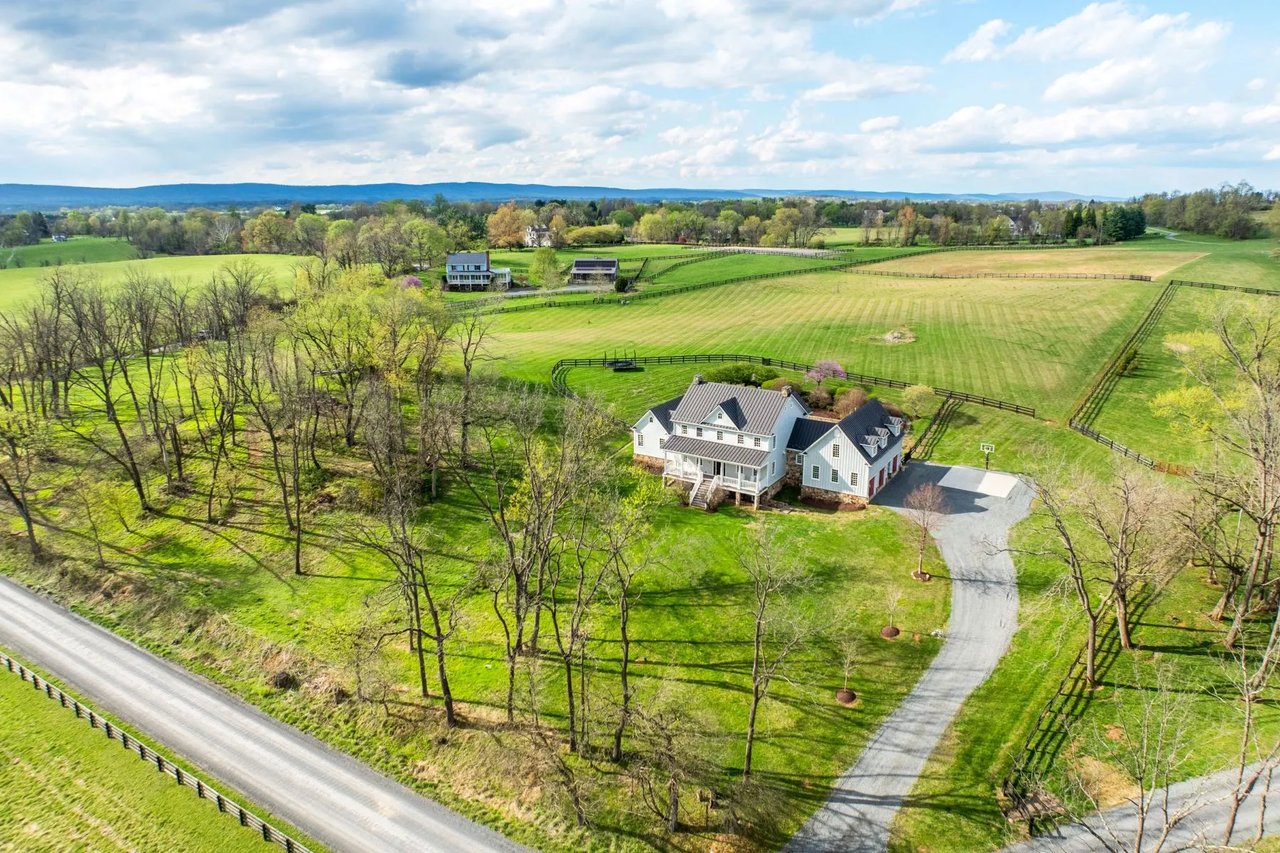
The real estate market reflects the community's extraordinary rarity. The median sale price for homes in Paeonian Springs is approximately $1.65 million, and the average home in the market has four or five bedrooms and more than 5,000 square feet of living space. Properties range from restored Victorian cottages in the historic village to custom estate homes on eight to fifteen acres of rolling countryside with west-facing views of the Blue Ridge and Catoctin Mountains. A 1810 Georgian manor originally part of a larger estate owned by Colonel James Hamilton, Loudoun County's first representative to the Virginia House of Burgesses, recently came to market, representing the kind of extraordinary historical property that makes Paeonian Springs unique in the Loudoun County real estate landscape.
Popular Neighborhoods
Paeonian Springs is not a community of subdivisions or planned neighborhoods in any conventional sense. It is a historic village surrounded by countryside, and the residential landscape is defined by the character of individual properties rather than the identity of HOA-managed communities.
The Historic Village Core is the architectural heart of the community, centered on Highland Circle, Simpson Circle, Berry Bramble Lane, Catoctin Ridge Street, and the lanes branching off Charles Town Pike. This is where the Victorian-era mansions, craftsman bungalows, and converted former commercial buildings survive from the resort period. Properties here sit on the Olmsted-influenced curved streets that John Milton surveyed in 1890, with gravel lanes and the generous setbacks and mature trees that define the village's look. The former Vanderventer Inn, the Chanbourne property, Buckhill III, the Shiflett House, and the former Spinks Mercantile building from approximately 1905 are among the notable contributing structures in the historic district. Owning a home here means owning a piece of a nationally registered historic district that cannot be replicated.
Quail Creek is one of the more well-known estate communities in the broader Paeonian Springs area, an enclave of larger homes on multi-acre lots where buyers seeking more land and newer construction while remaining in the Paeonian Springs vicinity tend to gravitate. Properties here are described as quintessential Hamilton and Paeonian Springs farmette living, with fenced pastures, deep front porches, and the kind of curb appeal that signals equestrian-ready acreage.
Beacon Hill is a neighborhood that appears in search results as one of the most popular residential addresses in the broader Paeonian Springs corridor, drawing buyers who want the western Loudoun lifestyle with estate-scale properties.
Old Waterford Road and Surrounding Estate Properties represent the upper tier of the Paeonian Springs real estate market. Properties along Old Waterford Road, Route 9, and the surrounding lanes feature estate homes on anywhere from five to fifteen or more acres, with views of Catoctin Mountain, working pastures, historic outbuildings, and the complete privacy that this corner of Loudoun County uniquely delivers. A 1810 Georgian manor on over six acres, lovingly restored and upgraded while preserving two centuries of character, sits in this corridor and represents the market's ceiling for buyers seeking something genuinely irreplaceable.
The Route 9 Corridor stretching west from the village toward Hillsboro and east toward Leesburg encompasses the rural residential landscape that defines how most buyers experience the Paeonian Springs area. Country homes on one to five acres, farmhouses on larger lots, and newer custom builds on private acreage with mountain views populate this corridor, which follows the original Charles Town Pike that connected Leesburg to the Blue Ridge crossings.
Schools
Paeonian Springs is served by Loudoun County Public Schools, one of the consistently top-ranked school districts in Virginia and the nation. The school pipeline for Paeonian Springs students runs through a small community-oriented elementary school, the Harmony Middle School in Hamilton, and Woodgrove High School in Purcellville.
Kenneth W. Culbert Elementary School is the primary public elementary school serving Paeonian Springs students, and it earns recognition as one of the best elementary schools in the broader Paeonian Springs area. The school is listed among the top-rated public schools serving the community, with a Niche grade that reflects strong academic performance within the highly competitive Loudoun County school system. The Kenneth W. Culbert Elementary School PTO maintains an active scholarship program, awarding annual college scholarships to former Culbert students who go on to Woodgrove High School, a continuity of community investment from elementary school through high school graduation that reflects the tight-knit character of western Loudoun school culture.
Harmony Middle School in Hamilton serves Paeonian Springs students in grades 6 through 8. Located at 38174 West Colonial Highway in Hamilton, Harmony is the only Loudoun County middle school designated as a Program Based Learning Design School, which incorporates a research-and-collaboration-based approach to learning rather than the traditional lecture model. Students at Harmony outperform both the district and state averages in math and reading, and the school's small size and community character make the transition from elementary school a notably smooth one for western Loudoun students.
Woodgrove High School in Purcellville is the high school serving Paeonian Springs students and is listed among the best schools in Paeonian Springs by Niche. The school serves communities including Purcellville, Lovettsville, Hillsboro, Waterford, Round Hill, Bluemont, and Paeonian Springs, with an enrollment of approximately 1,542 students, the motto "Work Honor Strive," and a GreatSchools rating of 8 out of 10. In 2024, the Woodgrove Wrestling team became the first Loudoun County Public School to win the state championship in wrestling, and the Woodgrove Girls' Basketball team won the Virginia Class 4 State Championship. The school offers Advanced Placement courses, career and technical education programs, and a full range of athletics and student activities.
Loudoun Valley High School in Purcellville is the other high school option accessible to some Paeonian Springs-area students depending on address, with a GreatSchools rating of 8 out of 10 and a similarly strong academic and athletic tradition. Homes.com notes that Loudoun Valley High School is among the best schools in Paeonian Springs, giving some families in the broader community a choice between two strong high school options.
For families interested in private education, the Middleburg Academy and other private institutions in the western Loudoun corridor are accessible within a reasonable drive.
Recreational Facilities
Paeonian Springs has no HOA amenity centers, no community pools, and no planned recreation complex. What it has instead is something far more unusual: the Washington and Old Dominion Trail running directly through the village on the original railroad right-of-way, Catoctin Creek flowing nearby, the Route 9 Market and Gardens of Delight nurturing the village's commercial and community life, and the surrounding countryside providing a natural recreational environment that most residents describe as irreplaceable.
The Washington and Old Dominion Trail Through the Village is the most distinctive recreational asset in Paeonian Springs, and it is one of the most historically layered trail experiences in all of Virginia. The W&OD runs directly through the village on the exact right-of-way where the Washington and Old Dominion Railroad once made eight stops a day during the resort era. Walking or cycling this stretch means traveling through living history, past the surviving Victorian structures of the resort period, along the gravel lanes that have not changed in over a century, and through the landscape that Washington lawmakers and summer visitors traveled by train to experience. The W&OD connects Paeonian Springs east toward Leesburg and west through Hamilton toward Purcellville, providing a flat, paved, 45-mile multi-use trail that cyclists and runners use as a primary outdoor corridor throughout the year.
Catoctin Creek and the Catoctin Scenic River flow through and near the Paeonian Springs area and represent a natural resource of unusual quality and distinction. The Catoctin Creek carries a scenic river designation from the Virginia Department of Conservation and Recreation, covering 16 miles through rolling, pastoral western Loudoun County before joining the Potomac River across from Point of Rocks, Maryland. Paddlers can float from Taylorstown to the Potomac on a two to three-hour trip through a beautifully intimate section of creek with shallow water, steep wooded banks, and abundant wildlife. The Catoctin Scenic River Advisory Committee actively works with surrounding landowners to protect the creek through conservation easements, and the landscape it flows through is among the most protected and scenic in all of Loudoun County.
Route 9 Market is a beloved local gathering point that functions as the community's informal social center, anchoring the village's commercial life with local products, farm-fresh groceries, and the kind of neighborhood general store atmosphere that gives small communities their identity. The market has been described by cyclists riding the W&OD and by local residents as one of the most welcoming stops in all of western Loudoun.
The Gardens of Delight Nursery is another community institution that gives Paeonian Springs its distinctive small-village character, offering locally grown plants, gardening supplies, and the kind of neighborhood business that reflects the community's deep interest in land, gardening, and connection to the natural world.
Temple Hall Farm Regional Park, operated by NOVA Parks just east of the Paeonian Springs area near Leesburg, provides additional recreational access with farm animals, seasonal events, nature trail walking, and a pastoral setting that draws families from across the western Loudoun corridor.
The Broader Wine Country and Farm Landscape surrounding Paeonian Springs functions as recreation in a way that is specific to this corner of Virginia. Catoctin Creek Distillery in Purcellville, the wineries of the Hillsboro and Hamilton corridors, Long Stone Farm's Sunday Supper events, and the farm stands and agricultural operations that populate the landscape along Route 9 create a food, beverage, and agricultural lifestyle that is simply part of the rhythm of daily life in Paeonian Springs.
Popular Hiking Trails
Paeonian Springs occupies one of the most trail-rich positions in Loudoun County, with the W&OD running through the village itself, Catoctin Creek and its corridor providing paddling and bankside access, and the broader western Loudoun trail network accessible within a short drive.
The Washington and Old Dominion Trail, Paeonian Springs to Purcellville is the trail that defines outdoor recreation in the village, and the western stretch from Paeonian Springs toward Hamilton and Purcellville is widely regarded as one of the most scenic and peaceful sections of the entire 45-mile trail. Rolling through beautiful farmland, past vineyards and horse pastures, with the Blue Ridge visible to the west and working farms on both sides, this section of the W&OD captures everything that western Loudoun countryside represents. Trail users have noted stopping at the Route 9 Market in Paeonian Springs as a favorite mid-ride destination, and the proximity to Longstone Farm and other local food producers along the route gives the ride a farm-to-table dimension unique to this corridor.
Temple Hall Farm Nature Trail is the closest designated hiking trail to Paeonian Springs, located just east of the village near Leesburg. The 1-mile loop winds through the park's wooded terrain past farm views and native flora and fauna. While it is a gentle hike more suited to a casual family outing than a serious workout, the setting of Temple Hall Farm, with its NOVA Parks naturalist programming, historic farm structures, and working agricultural landscape, gives it a character that purely recreational trail parks cannot match.
Ball's Bluff Battlefield Regional Park is among the most popular trail destinations accessible from Paeonian Springs, a short drive east toward Leesburg along the Potomac River bluffs. AllTrails identifies the Ball's Bluff Red and Orange Loop as one of the most popular trails near Paeonian Springs across all four seasons. The park encompasses over seven miles of walking trails, includes a portion of the Potomac Heritage Trail, and is home to one of the smallest National Cemeteries in the United States. The blufftop views of the Potomac River and the Civil War history embedded in every trail marker make it one of the most historically meaningful hikes in the region.
Red Rock Wilderness Overlook Regional Park is another consistently popular trail destination from Paeonian Springs, appearing on AllTrails as a top hike across all four seasons. The park, located along Edwards Ferry Road near Leesburg, offers several miles of moderate to strenuous trails through wooded terrain with panoramic views of the Potomac River Valley and historic ruins that add a layer of discovery to every visit.
The Potomac Heritage Trail is accessible from multiple points between Paeonian Springs and Leesburg and is noted by AllTrails as a popular trail near the community in every season. The trail follows the Potomac River corridor through some of the most scenic natural landscape in northern Virginia, linking Ball's Bluff, Red Rock, and river access points into a multi-mile natural corridor.
Point of Rocks to Harpers Ferry via the C&O Canal Towpath is accessible within about 15 minutes of Paeonian Springs and provides access to the 184-mile C&O Canal Towpath along the Maryland side of the Potomac. The Point of Rocks trailhead is set beside a stunning 1875 Victorian Gothic Revival train station and connects to miles of flat, shaded, river-adjacent walking and cycling on the historic canal towpath. Continuing north, the route eventually reaches Harpers Ferry and its dramatic confluence of the Potomac and Shenandoah Rivers.
Maryland Heights Trail at Harpers Ferry, approximately 25 to 30 minutes from Paeonian Springs, provides the most dramatic hiking accessible from the community. The 4.5-mile out-and-back climbs from historic Lower Town Harpers Ferry to an overlook with sweeping views of the river confluence and the surrounding mountain ridgelines, with Civil War history woven into every section of the ascent.
Sky Meadows State Park in Delaplane is approximately 20 to 25 minutes southwest and provides 22 miles of hiking trails on 1,860 acres of Blue Ridge Mountain terrain, including direct access to the Appalachian Trail. The open meadow and woodland landscape, with views stretching across the Piedmont, makes it one of the premier hiking destinations accessible from the Paeonian Springs corridor.
Churches
The faith community serving Paeonian Springs draws from the historic religious traditions of western Loudoun County and reflects the small-town, community-oriented character of the village itself.
The Catoctin Free Church holds a significant place in the history of Paeonian Springs, formed during the village's resort era by eleven people dismissed from the Leesburg Presbyterian Church, and serving the community through the early decades of the 20th century. The original church building no longer stands, but the congregation represents an important chapter in the village's religious history.
New Jerusalem Lutheran Church in nearby Hamilton, established in 1765 as one of Virginia's earliest Lutheran congregations east of the Blue Ridge Mountains, is the most historically significant active congregation accessible to Paeonian Springs residents. Its 1869 Late Greek Revival brick sanctuary and cemetery with Revolutionary War patriots' graves represent a profound connection to the region's earliest European settlement history.
Harmony United Methodist Church in Hamilton, at 380 East Colonial Highway, serves Paeonian Springs and surrounding communities with traditional United Methodist worship, a food pantry, missions outreach, community suppers, and a warm small-congregation character that reflects the rural community it serves.
Cornerstone Chapel in Leesburg, one of Loudoun County's largest non-denominational congregations with multiple Sunday services, draws many Paeonian Springs residents who prefer a larger congregation with extensive children's, youth, and adult programming, accessible within about 15 minutes east on Route 7.
St. Francis de Sales Catholic Church in Purcellville serves the Catholic community throughout western Loudoun County, including Paeonian Springs residents, with multiple Mass times, full sacramental programming, and a large parish community.
Ketoctin Covenant Orthodox Presbyterian Church in Purcellville offers a traditional Reformed worship option for Paeonian Springs residents with a confessional Presbyterian tradition, strong adult education programming, and a congregation committed to the historic Westminster Standards.
The broader corridor between Purcellville, Hamilton, Leesburg, and Hillsboro provides virtually every major denominational tradition within a comfortable drive for Paeonian Springs residents, and the community's small size means that residents often settle into the congregation that fits their faith tradition regardless of precise denomination.
Why People Love Living in Paeonian Springs
Ask anyone who has found their way to Paeonian Springs and chosen to make it home why they did it, and the answers share a single underlying logic: this is a place that cannot be found anywhere else, cannot be replicated, and cannot be manufactured.
The historic village is literally irreplaceable. The 58 contributing buildings of the Paeonian Springs Historic District cannot be rebuilt, reproduced, or approximated. The Victorian mansions on Highland Circle, the craftsman bungalows on Berry Bramble Lane, the former water bottling plant, the original springhouse site, the Olmsted-influenced curved street layout conceived by John Milton in 1890, all of these exist once, in this one place. Owning a home here is not purchasing real estate. It is accepting stewardship of a piece of American history.
The W&OD Trail runs through the front yard. In most communities, a great trail is a destination you drive to. In Paeonian Springs, the Washington and Old Dominion Trail runs directly through the village on the bed of the old railroad right-of-way. Residents step out their front door and are immediately on one of the finest multi-use trails in the mid-Atlantic, with Leesburg to the east and Purcellville to the west and 45 miles of paved trail connecting to the broader Northern Virginia trail network. That kind of built-in trail access is something master-planned communities spend millions trying to approximate.
Catoctin Creek is a scenic river flowing through the neighborhood. Living adjacent to a Virginia-designated scenic river, one that paddlers float, that conservation advocates fight to protect, and that flows through 16 miles of pastoral western Loudoun countryside before joining the Potomac, is a genuine natural asset that most communities would celebrate as their central amenity. In Paeonian Springs, it is simply part of the landscape.
The community's self-reported identity is exactly what it appears to be. Residents on Nextdoor describe the top reasons they love Paeonian Springs as community, quiet, peaceful, family friendly, dog friendly, hiking, parks, pleasant, and walking. These are not aspirational talking points. They are an accurate description of a village where gravel lanes lead to Victorian porches, the W&OD connects neighbors heading west toward Purcellville, and the dog-friendly character of the trails and green spaces makes daily outdoor life genuinely easy.
The land is protected. The conservation easement culture that defines the best of western Loudoun County is strongly present in and around Paeonian Springs. The Catoctin Scenic River Advisory Committee actively works with surrounding landowners to protect the creek corridor. The National Register listing protects the historic district's contributing structures. The rural character of the surrounding Route 9 corridor is sustained by agricultural zoning and a community that values the working landscape that surrounds it. Buyers who come here can be reasonably confident that what they see from their windows today will remain substantially intact for decades to come.
The commute is manageable for hybrid workers. Paeonian Springs sits at the intersection of Route 9 and Route 7, giving it direct access east to Leesburg and the broader Northern Virginia commuter network. Dulles International Airport is approximately 25 to 30 minutes east. The MARC commuter train station in Point of Rocks, Maryland is approximately 15 minutes north across the Potomac River, providing a car-free commute option to Washington's Union Station for residents willing to cross the bridge. For the growing population of hybrid and remote workers, the combination of extraordinary countryside living and reasonable commute access has made Paeonian Springs one of the most compelling discoveries in all of Loudoun County.
It is genuinely, wonderfully small. There is one small road sign in all of Loudoun County pointing the way to Paeonian Springs. The village has approximately 230 residents. The Route 9 Market and the Gardens of Delight are the commercial heart of daily life. The neighbors know each other. The gravel lanes are quiet. The Victorian porches face streets that have not fundamentally changed since 1905. In a region being consumed by suburban growth, Paeonian Springs is simply and stubbornly itself, and that is what residents love most about it.
Frequently Asked Questions About Paeonian Springs
Is Paeonian Springs a good place to raise a family?
Yes, for families who value historic character, outdoor access, excellent western Loudoun schools, and the kind of small-village community where children grow up knowing their neighbors. The school pipeline through Kenneth W. Culbert Elementary, Harmony Middle School, and Woodgrove High School is strong and community-oriented. The W&OD Trail provides immediate outdoor access for cycling, running, and walking. The broader western Loudoun countryside, with its farms, creeks, and trails, creates a genuinely enriching environment for children who thrive in natural settings. The trade-off is that major grocery shopping and most retail amenities require a drive to Purcellville or Leesburg, and the community is small enough that most organized youth sports programming occurs in neighboring towns.
How far is Paeonian Springs from Washington, D.C. and Dulles Airport?
Paeonian Springs is approximately 40 to 50 miles from Washington, D.C. and about 25 to 30 minutes from Dulles International Airport via Route 7 east and the Dulles Toll Road. The Point of Rocks MARC station in Maryland, approximately 15 minutes north across the Potomac River, provides commuter rail access to Washington's Union Station, making a car-free D.C. commute viable for residents whose work is accessible from Union Station. Route 7 east connects to the Dulles Toll Road and the broader Northern Virginia commuter corridor, and Leesburg is approximately four miles east for residents who need additional services.
What types of homes are available in Paeonian Springs?
The market is characterized by two primary categories: restored historic homes in the village core, ranging from craftsman bungalows and Victorian cottages to grander resort-era mansions, and estate properties in the surrounding countryside ranging from five-acre farmettes to expansive multi-acre estates with historic manor homes. The median sale price of approximately $1.65 million reflects a market where most homes have four to five bedrooms and more than 5,000 square feet of living space. There are no townhomes, condominiums, or conventional suburban subdivisions in this market. Buyers come here specifically for the character that only this community offers.
Does Paeonian Springs have an HOA?
The village of Paeonian Springs is unincorporated and has no HOA structure. The historic district's character is protected through its listing on the National Register of Historic Places and the Virginia Landmarks Register, which provide a framework for preserving contributing structures, but there is no homeowners association governing the community's appearance or use of private property. Rural estate properties and village homes alike carry no mandatory HOA fees, which is one of the qualities most appreciated by residents who have come from more heavily governed communities in eastern Loudoun.
What is the real estate market like in Paeonian Springs?
The market is extremely thin by volume, with typically fewer than ten properties listed at any given time. Homes spend a median of approximately 37 to 86 days on market depending on price point and condition, with the wide range reflecting a market where the right buyer for a historic Victorian manor home or a 15-acre estate may take longer to find than a move-in-ready craftsman bungalow. The median sale price of approximately $1.65 million reflects strong and rising demand from buyers who specifically seek this community's combination of historic character, trail access, scenic river proximity, and western Loudoun school quality. Working with an agent who specializes in western Loudoun and understands the specific nuances of the historic district and the surrounding estate market is essential for navigating this highly particular community.